Recently one user kindly pointed out that the translation of our app should be more precise. Because we translated "我想喝酒(wǒ xiǎng hē jiǔ)" into "I want to drink wine". She is right these two sentences are not 100% same. Although "我想喝酒(wǒ xiǎng hē jiǔ)" is a very common and nature Chinese sentence, its English version "I want to drink alcohol" sounds very weird.
This brings me a question: Why there are more collective nouns in Chinese than that in English? Actually English also has collective nouns such as "cat", "dog". For example people will probably say "I have a dog" instead of "I have a Shih Tzu". But if you take a close look, Chinese has much more: "牛(niú)", "羊(yáng)", "鼠(shǔ)", "酒(jiǔ)", "笔(bǐ)"… Early this year, western media had a report that 2015 was the year of "Yang" in China. Then Chinese noticed that different media used different words of "Yang". So we asked ourselves whether "Yang" was a sheep, a goat or a ram. Of course, no one knows.
I guess one reason is Chinese is an economical language. For all those collective nouns there are more specific secondary words. "Sheep" is "绵羊(miányáng)", "goat" is "山羊(shānyáng)" and "ram" is "岩羊(yányáng)". But no one cares what kind of "Yang" it is. It's just a symbol. When I say "我想喝酒(wǒ xiǎng hē jiǔ)", I only express I want to have a drink with alcohol. It is unimportant what kind of drink I want. So we try to deduct any redundant information. Meanwhile English has a reputation for being scientific, which needs to be precise.
Of course that's just a guess. There are also collective nouns used more often in English than that in Chinese. For example, I am always confused that there are so many "squash" in the grocery store. They are all different things for me. Another good example is we don't have an identical word of "dumpling" in Chinese. They are "包子(bāozi)", "饺子(jiǎozi)", "小笼包(xiǎolóngbāo)", "馒头(mántou)", "馄饨(húntun)"…
So one learning tip is when you learn Chinese, please try to understand a noun may not be the same thing that you learn from the translation. "酒(jiǔ)" is "wine" on your textbook but it could be "beer" as well.
BTW, do you have any suggestion how I translate 我想喝酒(wǒ xiǎng hē jiǔ)?

2015年11月15日星期日

2015年11月11日星期三
Are Chinese rude by not saying "谢谢(xièxie)" or "请(qǐng)"?
I once saw someone raised a question on
Quora: Why don't Chinese people say thank you amongst friends? Then my translator told me she couldn't
directly translate:给我一双筷子(gěi wǒ
yī
shuāng kuàizi) into English, because it's too rude. She has to add "请(qǐng)":
Please give me a pair of chopsticks. So it makes me think: Do foreigners think
Chinese are rude since we don't use "谢谢(xièxie)" or "请(qǐng)"
often?
When I was in America, I noticed people did
use "thank you" and "please" much more often than Chinese
did. For example, if a cashier gives you change, you should say "thank
you"; if you ask your friend to pass you something, you should say
"please". In these situations, most Chinese won't say "谢谢(xièxie)"
or "请(qǐng)". But I will say it's a culture difference rather than
we are rude.
In China, instead of saying "谢谢" to
strangers, we probably will smile at them. We likely say "谢谢(xièxie)"
when we sincerely appreciate someone. Meanwhile we prefer to use body language
to strangers. I guess one reason is in Chinese culture, people are usually too
shy to express oneself.
For "请(qǐng)", it's
another story. Most Chinese people will feel "too polite" if you use "请(qǐng)"
to someone you know, such as family, friends, coworkers. "请(qǐng)"
makes others feel that they are not that close to you. It's definitely good to
use "请(qǐng)" to strangers such as waiter, taxi driver or your
coworker on your first day.
In a word, it is a socially acceptable
behavior by not using "谢谢(xièxie)" or "请(qǐng)" in
China. But I won't say you need to cut down your words. It's always nice of you
to say "谢谢(xièxie)" and "请(qǐng)".
Secrets of Saying Sorry: “对不起”’s Correct Use
If you’ve ever learned even a little Chinese, you probably know the phrase “对不起(duì bù qǐ)”. In most textbooks, “对不起(duì bù qǐ)” is translated to mean “sorry,” or “I’m sorry.” Other books might say it means “Excuse me”. I often hear my beginning students use this phrase. However, you may notice that Chinese people don’t say it that often. Are all Chinese people being rude? Of course not! The difference is that “对不起(duì bù qǐ)” is not 100% the same as the English phrase “I’m sorry”. In Chinese, “对不起(duì bù qǐ)” is only used when you did something wrong, and caused trouble. Today, we will look at this simple but often incorrectly used phrase.
It’s common for an English speaker to say “sorry” when he or she feels sorry for someone else’s problem. For example, if I told you that I failed my TOEFL exam, you might expect to be able to reply “对不起(duì bù qǐ)”. However, instead of feeling comforted, most Chinese would feel confused by that reply. As we stated above, this phrase is only used when the person saying it did something wrong. It’s not your fault the person failed the exam! An appropriate response for this bad news could be:
啊?太糟了(a? tài zāo le)。Ah? That’s too bad.
别难过(bié nánguò)。Don’t be sad.
怎么会(zěnme huì)?How come this happened?
The only case you could use “对不起(duì bù qǐ)” in response to bad news is if you mentioned something that made the other person sad or uncomfortable. For example,
A:你的狗怎么样(nǐ de gǒu zěnmeyàng)?How is your dog?
B:我的狗死了(wǒ de gǒu sǐ le)。My dog passed away.
A:对不起(duì bù qǐ)!I’m sorry.
In this case, it’s your “fault” that you mentioned the sad thing, so it would make sense to use “对不起(duì bù qǐ)” to apologize.
One other time it’s appropriate to use “对不起(duì bù qǐ)” is when we might use the English phrase “Excuse me”. Again, if you’re causing someone trouble or inconvenience, then you can use “对不起(duì bù qǐ).” For example,
对不起,这是我的座位(duì bù qǐ, zhè shì wǒ de zuòwèi)。= Excuse me, but this is my seat.
对不起,请让我过去(duì bù qǐ, qǐng ràng wǒ guòqù)。= Excuse me, please let me pass.
对不起,请再说一遍(duì bù qǐ, qǐng zài shuō yíbiàn)。= Pardon me, please say it again.
Aside from “对不起(duì bù qǐ),” there are always other phrases one might hear a lot in Chinese. One of these is “不好意思(bù hǎo yì si),” which also means “sorry,” but is not as emotionally strong as “对不起(duì bù qǐ).” In most cases, “不好意思(bù hǎo yì si)” is equal to “excuse me.” For example, if you accidentally bump into someone, “不好意思(bù hǎo yì si)” is a good choice.
Another often-used phrase is “抱歉(bào qiàn)”. This one is quite formal, but is still used very frequently, especially in Taiwan. “抱歉(bào qiàn)” is often preceeded by “很(hěn),” which intensifies it. For example:
我们没有完成合同,我很抱歉(wǒ men méiyǒu wán chéng hétong, wǒ hěn bàoqiàn)。We didn’t complete the contract. I feel sorry.
我不能参加这次会议,我很抱歉(wǒ bù néng cānjiā zhè cì huìyì, wǒ hěn bàoqiàn)。I can’t attend this meeting. I feel sorry.
Because of how formal this phrase is, it typically doesn’t carry much emotional weight. As a native speaker, I usually won’t use this phrase with my friends.
Now you know the secrets of saying “sorry” in Chinese. So, next time your Chinese friend tells you they failed their exam, don’t say “对不起(duì bù qǐ)!” Unless, of course, you caused it to happen.
2015年6月14日星期日
The way to express possession in Chinese.

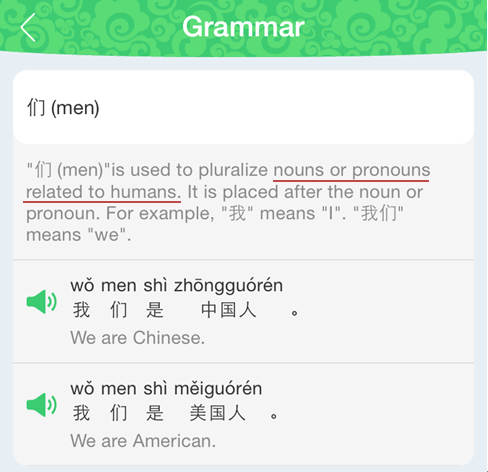
Read
the underlined words three times please! Actually, there is no word like 们 in Chinese to indicate plural
form of animals or things. Normally we use number and measure word before them
to tell the specific amount. That's another story.
Today,we are going to discuss the way
to express possession.
In English, we use “
’s ” to indicate it, and in Chinese, we have the same use of the character“的“(de).

Now,
let’s do a quiz ~

Ha Ha Ha~Be relaxed, I know it seems like a mess at the first sight, but just calm down and take a deep breathe, I believe that you can
make it !!!
The answer will be released next time!
Come on! Leave your answers below and show yourselves!!!
2015年6月9日星期二
How to express plural form in Chinese?
How
to express plural form in Chinese? Hey, nǐ hǎo. Hey, nǐ and nǐ hǎo? No!!! Absolutely
not!!!

That's
how we indicate the plural form. Stop adding s after nouns or using countless 和(hé, and) in Chinese.
Now
it's time for you to prove that you can grab Chinese grammar within a minute! Let's
go!!!
Please
change the following words into plural form:

The
answer will be released next time! Before that, please leave your answers blow
as a comment.
订阅:
博文 (Atom)